

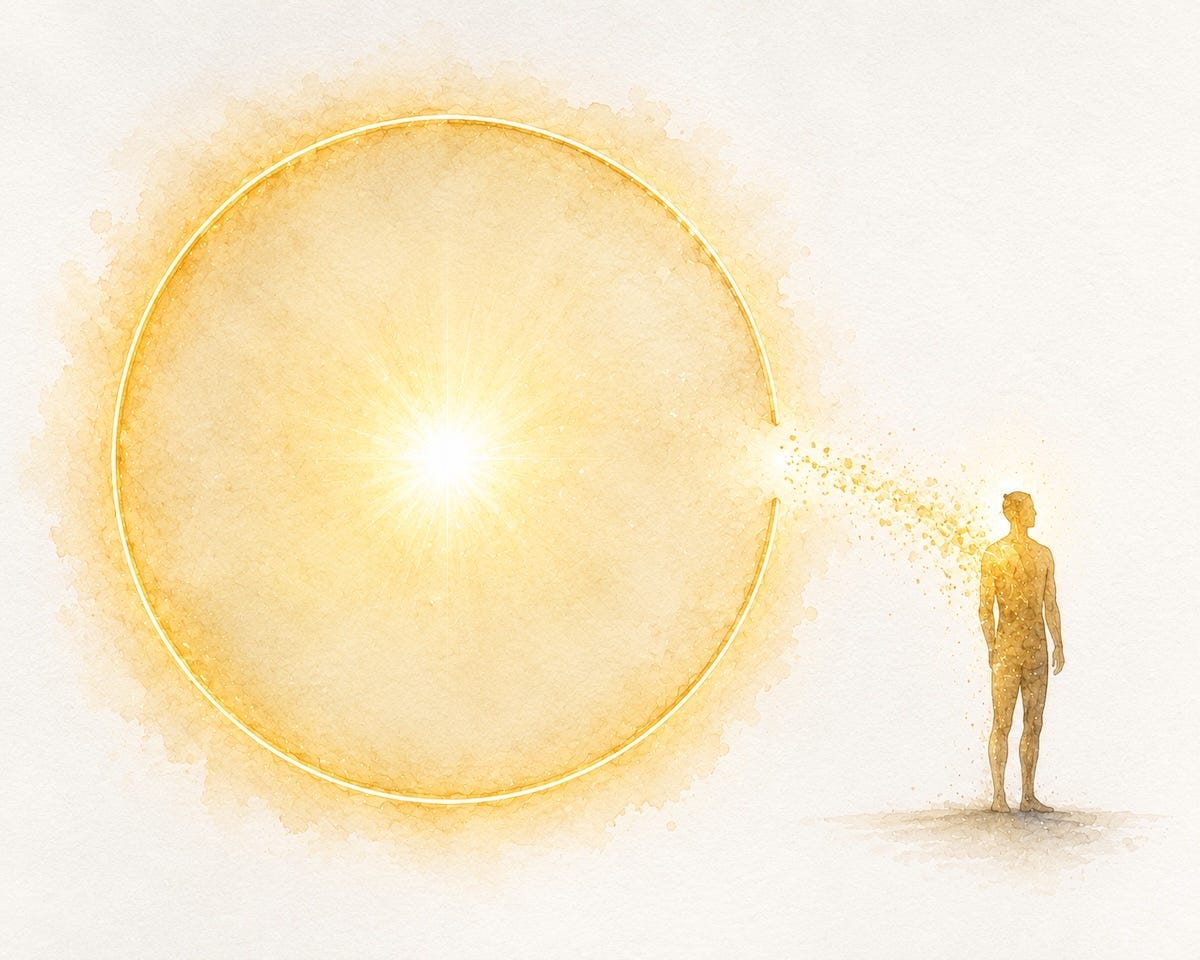
For thousands of years, great minds—like Plato or Apostle Paul—have said we’re made of three parts:
Body. Mind. Soul.
The body? Simple. It’s what we see, touch, and feed.
The mind? A little harder. Some say it lives in the brain. Others say it spreads through the whole body. Or even beyond it.
But the soul?
Ask ten people what it is… and you’ll get twelve different answers.
So here’s ours:
The soul is the frequency of individuation out of infinite oneness.
In the language of physics, it’s the Planck length:
1.6 x 10⁻³⁵ meters.
The smallest unit we can measure.
Beyond this point, there is no “thing,” no matter. Only essence.
At this scale, the laws of physics as we know them cease to apply.
Below this point unity ends… and separation begins.
Energy turns into matter.
One becomes many.
You become you.
From that moment of individuation, the world of duality begins:
Positive and negative.
Right and wrong.
Me and not-me.
But here’s the part most people miss:
The more you reject what you see in others, the more you separate from yourself.
“I’m not like them.”
“I’d never do that.”
“That’s not me.”
Each of those moves you one step further from your soul. Towards the material world.
And in time, too many separations become gravitational.
You feel heavier.
Life feels harder.
And you don’t quite know why.
The answer?
Integration.
When you reclaim the parts you’ve pushed away…
When you embrace the opposites you’ve judged or denied…
When you can say, “Yes—I am this and that”…“I also do this and I do that”...
…you return home.
Back to your soul.
Back to your essence.
You become yourself to the degree you make everyone else yourself.
Love & Wisdom,
Monica and Stefan
P.S. You need both separation and integration to live in this world. The key is finding the balance between them.