

Our client, who we’ll call Olivia, grew up in the North of England, and her story begins at her grandmother’s kitchen table. She was seven years old.
Her family worked the weekend markets, selling fruit and vegetables from a stall with a striped canvas roof, crates of apples and potatoes stacked high and handwritten price signs blowing in the wind. Often they stood there in the cold and the rain, and every sale was paid for in cash.
Every Sunday evening, once the stalls were packed away, her whole family gathered at her grandmother’s house, around a table so long it stretched the length of the kitchen. Cousins squeezed onto benches, plates passed hand to hand, and four conversations ran at once. It was the loudest, warmest room she knew.
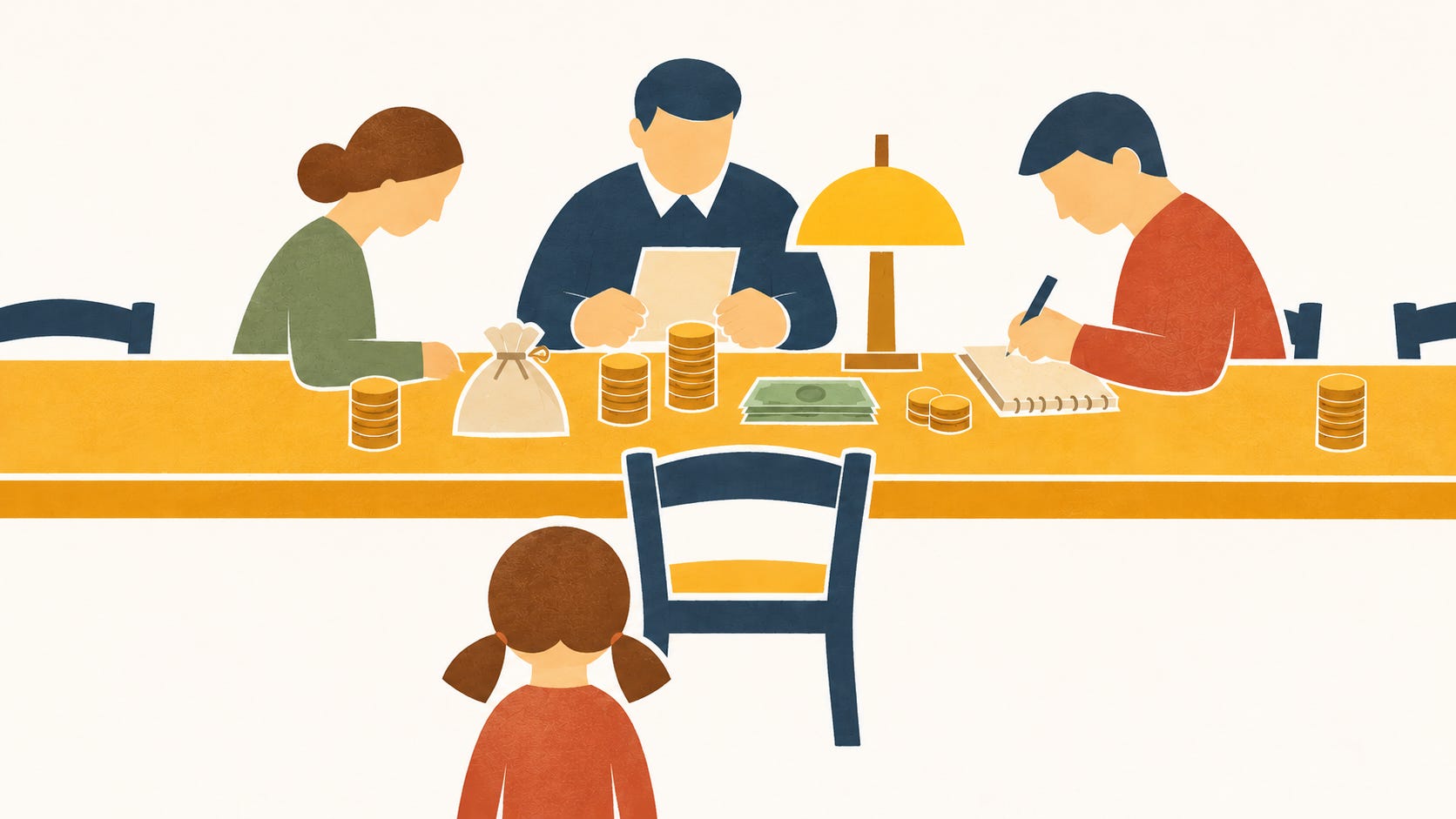
Soon after they finished eating, the plates were cleared, the room fell silent, and the counting began. The table that had held dinner now held the week’s takings from the market stall. There were coins stacked carefully, notes smoothed flat, plastic bags organized neatly, a notebook and a pencil, and a single dim lamp pulled low over the table.
Around it sat the adults of the family, her father, her aunts and uncles, minds focused, lips moving, losing count and starting again. Every coin had been earned from a long market day, and it had to cover the family’s rent, food and next week’s stock, so nobody was going to lose a penny. It took hours, every Sunday, for years.
Seven-year-old Olivia stood in the doorway, watching. “Don’t disturb them,” her mother said. “They’re counting.” Olivia watched her father, her aunts and her uncles, the people she loved most, go somewhere she couldn’t follow. Their eyes stayed fixed on the money, and there was no time for her. In that moment, she learned her first lesson about money:
Money is scarce, and it makes the people you love disappear into it.
By the time Olivia was ten, she had watched that ritual hundreds of times. And one Sunday, she gathered every bit of courage she had, stepped over the invisible line of the doorway into the forbidden hours of the counting, and asked, “Can I have some money for the tuck shop?” She had a school trip coming up and wanted sweets like the other children.
The room stopped. Pencils dropped. A total someone had just reached was lost, and the counting would have to start again. Her aunt shook her head, her father looked at her with what felt like sheer disappointment, and the silence stretched until she could hear the kitchen clock and her own heartbeat. Nobody gave her any coins, and nobody said a word to her for the rest of the evening.
Her cheeks burned, and she walked back to the doorway, feeling too loud, too much and ashamed for asking, which is where her second lesson sank in:
If you reach for money, the people you love look at you with disappointment.
So she never asked for money again, and she never spoke about that evening, not to a friend, not to a partner, not to anyone. In time, she forgot it altogether.
From that day, Olivia lived by two subconscious rules:
1. Money is scarce, and it makes the people you love disappear into it.
2. If you ask for it, the people you love will look at you with disappointment.
In her direct words, “Money and family don’t go together. I don’t want any big money that’s going to draw me away from family.”
Fast forward to the start of 2026…
Olivia was now a qualified counselor in her mid forties.
Every day she drove to her job at the local authority, where someone else decided who she saw, when she saw them and what she was paid. For years she had carried a dream of a practice of her own, with a price that paid her what her work was worth. She envisioned a sunlit studio with two armchairs and an amber glowing lamp, her name painted on the glass of the door, and a fully booked calendar.
Every weekend she sat down to price her first private package, opened a blank page, typed a number and deleted it, the cursor blinking back at her like a pulse. Her shoulders rose toward her ears, and her stomach tightened the way it had in that kitchen. She had been someone who gave generously, lending and gifting her time and service, yet the moment she tried to ask for more for herself, her body pulled back.
The sensible thoughts always arrived right on time: ‘People who need help shouldn’t have to pay more for it.’ ‘I need one more training course before I can charge for this.’
Sound familiar? Olivia called it good judgment, closed the laptop and made a hot cup of tea, feeling relieved, without ever really knowing what she was relieved about. What she couldn’t see was that the reflex to pull back came from a ten-year-old who was told no when she asked for money.
Olivia lived like this for years. Until one day,...
….in the Spring of 2026, tired of watching that cursor blink on a blank page of her business plan, she did something she had never done before and invested her savings in herself. She signed up for the Inspired Money Foundation, a ten-week program which addresses the deep-rooted patterns that prevent your income from growing.
And because she was courageous enough…
…to invest in herself, she discovered support through the program she had never had before.
Each morning she met her program partner on a call to look at what stood between her and the practice she wanted, and for weeks she turned up without knowing exactly what she was looking for. Then one morning her partner asked her to find the first time she had learned it was dangerous to ask for money.
At first, Olivia struggled to answer, and then suddenly the memory came back to her. She was ten years old again, standing in her grandmother’s kitchen. The lamp hung low over the table. Coins clinked in tall stacks, the clock ticked, and her father looked up with that look of disappointment. Her face burned, her throat closed, and her eyes dropped to the floor exactly as they had at ten.
Her partner did not hurry her. She asked one slow question after another, allowing space for the discomfort, and Olivia stayed with the process. Slowly, the memory began to soften. She could revisit her grandmother’s kitchen table through the eyes of the woman she had become.
She saw a tired man at the end of a long week, counting money he had earned in the cold and afraid of losing what the family had worked for, and a little girl who had only wanted sweets and a seat at that table. The look that Olivia had interpreted as losing her place within the family had simply expressed his worry about money.
As the perception dissolved, her face cooled, her throat opened and her shoulders dropped. For the first time she knew in her body that it was safe to ask for more and safe to earn more, and that she could do both and still belong to the people she loved.
The shame she had carried around money for decades was gone. “The feeling is no longer there,” Olivia told us. “I no longer experience the burden I was carrying.”
And because of that,...
…a new energy came into her. Over the following weeks, she developed her new offering and built a page for her practice that she felt represented her beautifully. She worked on her offer until midnight, the desk lamp pooling gold across her notes, and she awoke inspired to keep taking steps to bring her business to life.
For now, she kept her job at the council, because its steady pay covered her bills. But she wanted her time back. One morning she knocked at her manager’s door: “I’d like to move to four days a week,” she said, and waited. Her manager looked up from her screen, nodded and said yes. It was as simple as that. From then on, Fridays belonged to her.
Finally,...
…on a Friday in September, her phone lit up with a message. The woman from her community, who had spent months asking whether Olivia saw people privately, had seen her new website go live. “I just saw your page,” she wrote. “What does a session cost?”
Olivia read it once and set down her tea. Her breathing stayed slow, and her shoulders stayed low, and she typed the number without a flicker of the old hand pulling back. “$200 for the session”, three times what the local authority paid her for the same hour. She pressed send, and within a minute the reply came. “That sounds fair. Sign me up.”
The following Friday, they sat across from each other in a room Olivia rented by the hour. The space had two armchairs and a lamp glowing amber, so close to the studio in her dreams - that Olivia’s heart warmed. The client’s shoulders were already easing, and Olivia felt a spark as her work came alive.
Ever since that day,...
…Olivia asks for what her work is worth. She is building a practice of her own, with her own clients and her own rates, and she told us, “I know I can earn $1 million, and I will be investing it into growing my practice.” She is no longer the child in the doorway watching her family count scarce coins. These days, she has a seat at the table, and when she counts, she’s counting what she’s building.
Love and Wisdom,
Monica and Stefan
P.S. Olivia had forgotten that Sunday completely, and for decades it decided her actions. Somewhere, a buried memory of yours may still be deciding what you dare to build. That’s why it’s so important to work on your past.