Vienna, 1840s.
Two maternity clinics. Same hospital. Same city.
Yet one felt like a death sentence.
In the clinic run by doctors and medical students, women died of Puerperal fever at terrifying rates. Almost 1 in 5.
Next door, in the midwives’ clinic, far fewer women lost their lives.
But, there was a young doctor who refused to look away. His name was Ignaz Semmelweis.
He began noticing what others dismissed.
Doctors moved straight from autopsies to childbirth.
No washing. No pause. No second thought.
Then a colleague died after a scalpel cut during an autopsy.
Same symptoms as the mothers.
That was the moment. A quiet, dangerous realization:
Death was traveling… on their hands.
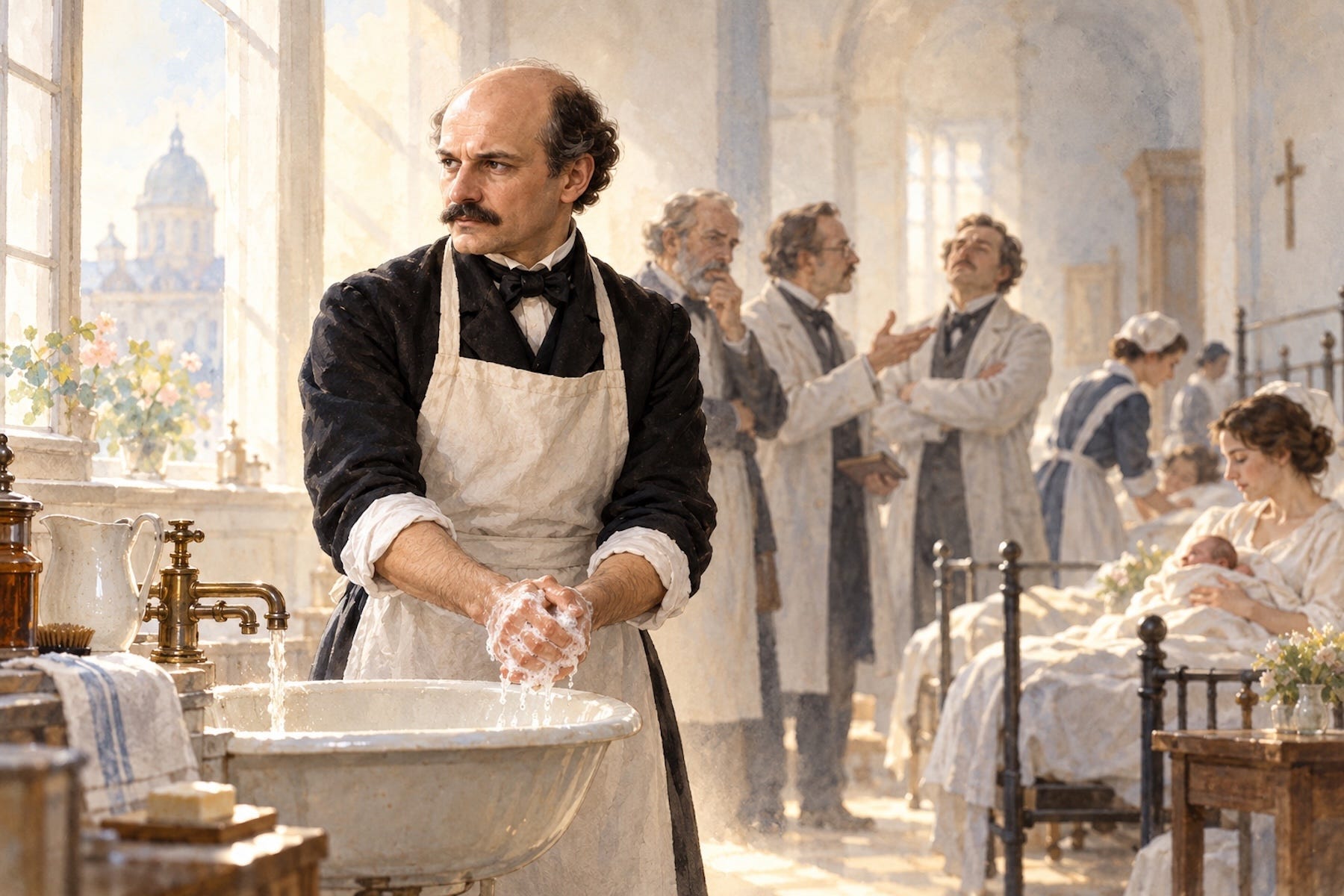
“There must be some very tiny organisms on our hands that we can’t see,” he thought.
Then he changed something simple: wash hands with chlorinated lime before examining patients.
The result?
Immediate. Staggering in its clarity.
Mortality dropped from 10–20%… to nearly 1–2%.
Many lives were saved. Many mothers survived.
Proof was standing in the ward.
And yet, something strange happened.
No one applauded.
Because Semmelweis couldn’t explain why in scientific terms. Germ theory of disease didn’t exist yet.
To his peers, his claim sounded absurd:
“Invisible organisms on our hands are killing patients.”
They laughed.
But worse than laughter was the implication.
If he was right… then they were the cause.
Doctors, seen almost as gods, faced an unbearable idea: we are killing the people we are meant to save.
Pride closed the door that evidence had opened.
And Semmelweis, frustrated and relentless, became more and more vocal.
He openly condemned his colleagues, and they sidelined him. Proof alone was not enough when it threatened identity.
In 1865, colleagues had him committed to an asylum under false pretenses.
Inside, he was beaten and a wound became infected.
At 47, he died… from the very kind of infection he had fought to prevent.
A few years later, through the work of Louis Pasteur and others, germ theory became accepted.
And the world finally caught up.
“Oh my… Do you remember that colleague of ours whom we thought was crazy and had locked away in an asylum? He was right.”
History repeats this pattern.
Socrates.
Giordano Bruno.
Semmelweis.
People who saw something clearly… before the world had the wisdom to understand it.
They stood for it.
And paid for it.
Today, in our modern society, we worship evidence-based science.
If it isn’t proven, it isn’t real.
Yet some visions appear before they can be proven, waiting for the world to catch up.
How can you tell the difference between a real vision and a fantasy?
What in your life are you not considering because it isn’t proven?
There are two questions we invite you to reflect on today and, if you wish, to answer in writing. Let your hand write half a page or a full page, then see what you wrote.
Love and Wisdom,
Monica and Stefan