

Starting today, you’ll receive one message from us about each of the 7 Universal Laws:
The Law of Duality
The Law of Reflection
The Law of Transformation
The Law of Synchronicity
The Law of Eristic Escalation
The Law of Order
The Law of Fractals
Today we begin with
the Law of Duality
which states that
the whole is made up of complementary opposites.
In the world of the senses, everything has an opposite. But the opposite is not the enemy.
It is the part that completes the picture. The complementary force that creates balance.
The ancient Egyptians and Greeks, and many philosophers such as Heraclitus and Hegel, all intuited the same truth: opposites are complementary.
You cannot have day without night. Nor peace without conflict.
Everything is created and transformed between these poles.
3 historical perspectives on Duality
Heraclitus said “All things come into existence through conflict of opposites”
The ancient Egyptians believed that order (Ma’at) and chaos (Isfet) maintain cosmic balance.
Hegel believed that thesis and antithesis give birth to a higher synthesis — in other words, evolution.
But we’re not writing this to give you a history lesson. We’re writing so you can see how this works in real life.
A true story from Monica’s experience
When my daughter, Elena, was about 10 years old, her messiness pushed me over the edge. It wasn’t just that she left a trail of things behind her wherever she went—it was that she couldn’t see it. If it had been contained to her room, maybe I could have tolerated it. But no—her clutter spilled over into every space I considered mine.
The kitchen counter, where I tried to maintain some semblance of order, became a battlefield of half-finished projects. The living room, my one sanctuary where I longed for stillness, turned into a chaotic mix of books, markers, and crumpled papers. The dining table, meant for family meals, was overtaken by her latest obsession. Even my own bedroom didn’t escape her reach.
It wasn’t just the mess. It was the constant frustration of picking up after her, tripping over her shoes, only to find her socks abandoned right beside them. No matter how many times I reminded her, it was as if she didn’t see the mess. Worse, she didn’t seem to notice how hard I was working to keep our home from descending into utter chaos.
With a degree in psychology and sociology, I thought I knew what to do. I understood motivation, so I thought I should have been able to figure this out. I tried every method I could think of.
First, I tried being patient—explaining, showing her how to do it, and even praising her for small efforts. I even resorted to rewarding her, thinking that would work. But nothing shifted.
Then I tried something more forceful—threats. “If you don’t clean up, no cartoons for you today,” or “You won’t be going to your friend’s house.” I felt myself slipping into a place I didn’t want to be, resorting to methods that felt manipulative. It was awful. And none of it worked.
The frustration mounted every day as I walked through the house, tripping over her belongings again and again. The mess never seemed to change, no matter how many times I asked, reminded, or pleaded. And at my lowest, I felt the urge to physically punish her as my parents had done to me. I knew it wouldn’t solve anything so I didn’t act on it, but it was a sign that I was reaching my tipping point.
I dreaded the thought that if she was like this now, at 10 years old, what would happen when she became a teenager and what kind of arguments we would have then.
So one day, I decided enough was enough. I had to tackle this differently—it was getting under my skin far too much.
I turned to the law of duality, a principle that says for every trait someone shows, they also possess its opposite in equal measure, even if it’s hidden. I asked myself, “Where does Elena show the opposite of this behavior? Where does she demonstrate order?”
It wasn’t easy at all to find answers because I had a huge judgment about the fact that she wasn’t orderly. Fortunately, this charge wasn’t so overwhelming that I couldn’t work on it on my own.
I realized that in the four years she had been in school, she had not once forgotten a notebook at home, even though I did not check how she packed her schoolbag. Her teacher had never complained that she forgot to do her homework. She did her homework, didn’t forget her notebooks—and managed this all by herself, because I didn’t check on her.
Then, I took a step back and asked myself where she demonstrated order in her own space. That’s when I saw it: Elena had a small collection of children’s makeup items—neatly organized, color-coded, and arranged by category. Nail polish was all in one spot, eyeshadow in another, lipstick perfectly lined up. In that chaos, there was a hidden order—one I hadn’t seen because I’d been too focused on her mess.
She also had a set of fancy clothes she had received from abroad, special ones. And those were also orderly and well-kept.
At that time, she was attending ballet classes. It struck me that she hadn’t missed any ballet lessons. She was focused. She packed her ballet equipment herself because she went straight there after school. I didn’t have to remind her, “you have ballet today, take your gear with you.” She had her ballet equipment with her when she needed to.
So, when it came to the things that were important to her, she was orderly. She had order in her own form, just not in the form that I was expecting.
Do you realize what it means for a child between the ages of 7 and 10 to have that kind of discipline without anyone reminding them—to check their notebooks against the schedule, not confuse days or times, take their equipment when they have ballet, and think about which days they have classes and bring the gear? It’s a pretty big deal.
Where I once saw her as the embodiment of messiness, I now realized that she also had a sense of order. Not only that, but I saw that she had order in equal measure to the disorder I had previously perceived.
Two days after I had the realization about her, she tidied up her schoolbag on her own without me having to say a word. She took out her things, got rid of the sandwich forgotten there for 2 weeks, and organized everything.
The next day, she cleaned out her school locker and her room. She did that on her own, without me giving her any directives. And since then, we haven’t had a single argument about messiness. That was it.
There are no mistakes in the universe,
Monica and Stefan
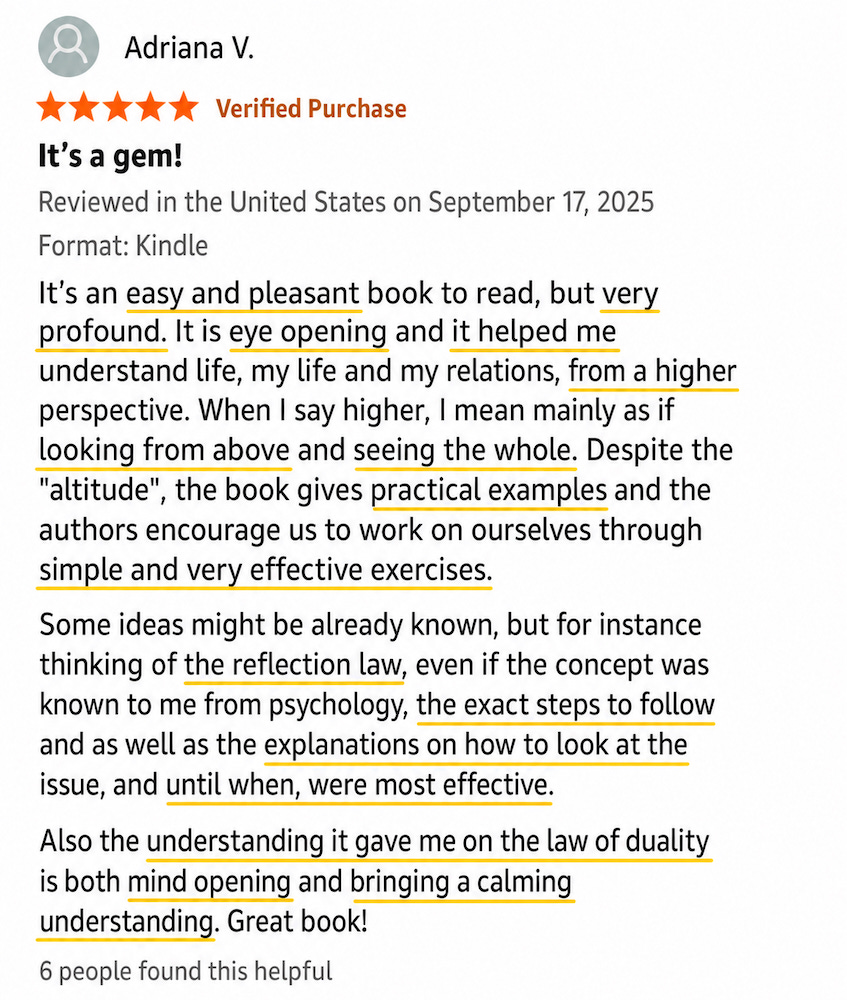
P.S. The story above is taken from the book “The 7 Universal Laws.” If you want to discover more stories and learn how to apply the universal laws to solve difficult problems, read or listen to the book.


(If the link doesn’t work, please go directly to your country’s Amazon website)



More from Monica, Stefan and the Inspired Life Circle team.
Join us at the next live, free, online workshops here.
June 9 - Discover the 7 Ways Rich People Think That No One Ever Told You

A live intensive workshop with Monica Ion, founder of the FTP Methodology, for high-achieving professionals whose income, confidence, and growth stalled, despite their effort and ambition.