

Today we’re talking about the fourth universal law. In our view, it is the most elegant — and the most challenging:
The Law of Synchronicity
This law says that in every moment — even right now, as you read these words — you experience both support and challenge in perfect balance.
Pain and pleasure. Gain and loss. Complementary opposites are equally present in every moment.
Everything is simultaneous. Everything is connected.
Synchronicity is the living expression of universal balance.
It is the Law of Duality applied to every moment — not just understood mentally.
And to truly work with it, you need a different frame of reference, beyond cause and effect.
Who spoke about this law
Niels Bohr observed that in quantum entanglement, pairs of particles are not separate entities, but part of an indivisible whole — and their separation is only an apparent illusion.
Carl Jung saw how the inner world and the outer world touch each other in a mysterious dance, not through causality, but through deep meaning.
John Demartini observed that life is based on this constant interaction of dual forces in every moment — support and challenge, pain and pleasure, benefits and drawbacks — all perfectly synchronized.
A true story from Monica’s experience
Several years ago, I worked with a client named Anna, a young woman with striking blue eyes that brimmed with emotion when she spoke. She harbored a great deal of resentment toward her father because she perceived that he had “never” supported her financially or emotionally. Whenever clients use absolute words like all, everyone, never, always, every time, none, or nobody, it’s a sign that there’s a strong emotional charge. In such situations, most clients need support because they can’t balance their perspective on their own.
Anna’s relationship with her father made her see men as adversaries. She also shared that she was stressed and struggling with anxiety, which was disrupting her sleep. It was clear that the resentment she harbored towards her dad was taking a toll on her well-being.
In our fourth session together, I invited her to apply the law of synchronicity: “Anna, please go to a moment when you perceive that your father did not support you financially and emotionally in your development.”
“Well, it happened during that situation in 11th grade I mentioned earlier,” she said.
“Who did the equal opposite in that exact moment?” I asked. “Who supported you financially and emotionally?”
“Me,” mumbled Anna, without much thought, her eyes cast downward.
“In this context, that is not the answer we’re looking for, Anna.”
“Why not?” she asked, lifting her gaze from the floor and looking at me with a puzzled expression.
“If the force bringing you the challenge comes from outside you, then to compensate for that challenge, you will find support from the outside that balances your perception. The law of synchronicity tells us that the inner compensates the inner, and the outer compensates the outer. In other words, if you give yourself a challenge, you also give yourself support. But if someone outside you gives you a challenge, someone else from the outside offers support.”
“So, it wouldn’t be correct to think that my father gave me a challenge and I gave myself support?”
“That response is not in line with our working philosophy because it would imply that, for you to be ‘good,’ someone else must be ‘bad.’ If we were to think this way, it would mean that someone would always play the role of the villain in your life. And we don’t want that. If we affirmed this mindset, you would remain stuck in the victim narrative. You’d continue to say, ‘I’m suffering because of someone else, but that makes me strong.’ As a result, you wouldn’t transcend duality and would remain trapped in the same story.”
She became thoughtful once more, her eyes dropping to the floor. “Okay, I understand now.”
“In that exact moment in your room, when you were in 11th grade and you perceived that your father didn’t support you financially and emotionally, who did the equal opposite? Who supported you financially?”
“There was no one there—I was alone.” She stiffened, her jaw set as she crossed her arms.
“Anna, even if there wasn’t a physical presence, connect with the moment and see who offered you financial and emotional support in your development.”
“What do you mean?”
“Tell me, where are you at that moment?”
“In my room.”
“Where exactly? What do you see around you?”
“I’m on my bed—it’s light outside.”
“What are you wearing?”
“Orange pants and a grey, striped shirt.” Her voice softened and her speech was visibly slower.
“What is the bed like? What’s on it?”
“A soft blanket, like a quilt, ” she said, sounding almost wistful.
“What do you hear? What sounds are around you?”
“The window is open—I hear voices, cars, and birds chirping.”
“Excellent. You’re fully anchored in that moment. Now, please, pause in the frame where you perceive your father isn’t supporting you financially and emotionally. Pause in that moment where you feel he’s not supporting you. Have you found the moment?”
“Yes, I’ve paused it.”
“Good. What would be the opposite of what your father is doing at that moment? What would he ideally do instead of not supporting you?”
“He would trust me and give me money to go to college.”
“Stay in that moment, Anna. You’re on the bed, in your orange pants and striped shirt, feeling the soft blanket and hearing the sounds around you. Stay there. Now, at this moment, who offers you financial support to go to college?”
“No one. There’s no one there.”
“Pause there. In this exact moment, when you perceive that your father isn’t supporting you, who is doing the opposite? Who is offering you trust and financial support?”
The silence in the room was thick, and as I watched Anna’s clenched fists, I realized that the emotions she had been holding inside were about to come to the surface. She unclenched her fists, her palms sweaty, her breath shallow.
Then she said, “My grandfather! His words were in my head telling me he would sell his land if that was needed and give me the money to go to college.” She burst into tears. I felt a cold shiver down my spine. What a powerful and certain response!
This realization was very important for Anna. The moment she saw the support—especially from a man—she was freed from the polarization that made her believe only women supported her and men did not.
We continued with a series of synchronicities, but no more than 9. When we look for those moments of judgment to balance them with the law of synchronicity, we realize there are relatively few.
This simple realization is truly liberating because we understand that we’ve been telling ourselves lies our whole lives by generalizing and distorting reality. Until now, Anna had lived with the perception that men had never supported her, so these moments of realigning reality brought a profound and different understanding of life.
I wasn’t very surprised when, at the end of the session, Anna told me, “Monica, I had support all along—how incredible! I can’t believe how blind I’ve been to it. I was so attached to the idea that the support had to come from my father, that I ignored all other forms of support. My grandmother, my grandfather, my teachers—they were there for me this whole time.”
“That’s right, Anna. Nothing is missing. You have everything you need. It’s just that sometimes the form in which you receive support isn’t the one you expect.”
“Yes—my father didn’t support me the way I wanted, but that doesn’t mean I wasn’t supported. It’s like I got stuck on a single idea and refused to see the rest.”
“That’s the main lesson. Sometimes we get so attached to a certain form or expectation that we lose sight of what we already have.”
“Nothing is missing,” she whispered, in wonder. “You’re right, Monica. I had everything I needed, exactly in the form I needed it.”
“And how does this discovery make you feel?” I asked her.
“Free. Light. And grateful.” She closed her eyes for a brief moment, as if savoring the weightlessness of her inner state.
Two days later, Anna called me to say she had slept through the night for the first time in years. She also told me that she had received a call from her father that morning. For no reason at all, he called her to say that he wanted to see her. He’d never done that before.
“Monica,” she said, “can you believe that he’s never initiated a visit? Today was the first time he’s ever done that!” It’s amazing how when we change something within ourselves, those around us respond differently, often with newfound warmth and openness.
Anna’s story reveals a powerful truth about the law of synchronicity: support is always present, but may be not in the form we expect. Her shift from resentment to gratitude, when she finally understood that she lacked nothing, serves as a reminder that seeing both support and challenge simultaneously transforms our perspective, offering a deeper sense of self-mastery.
There are no mistakes in the universe,
Monica and Stefan
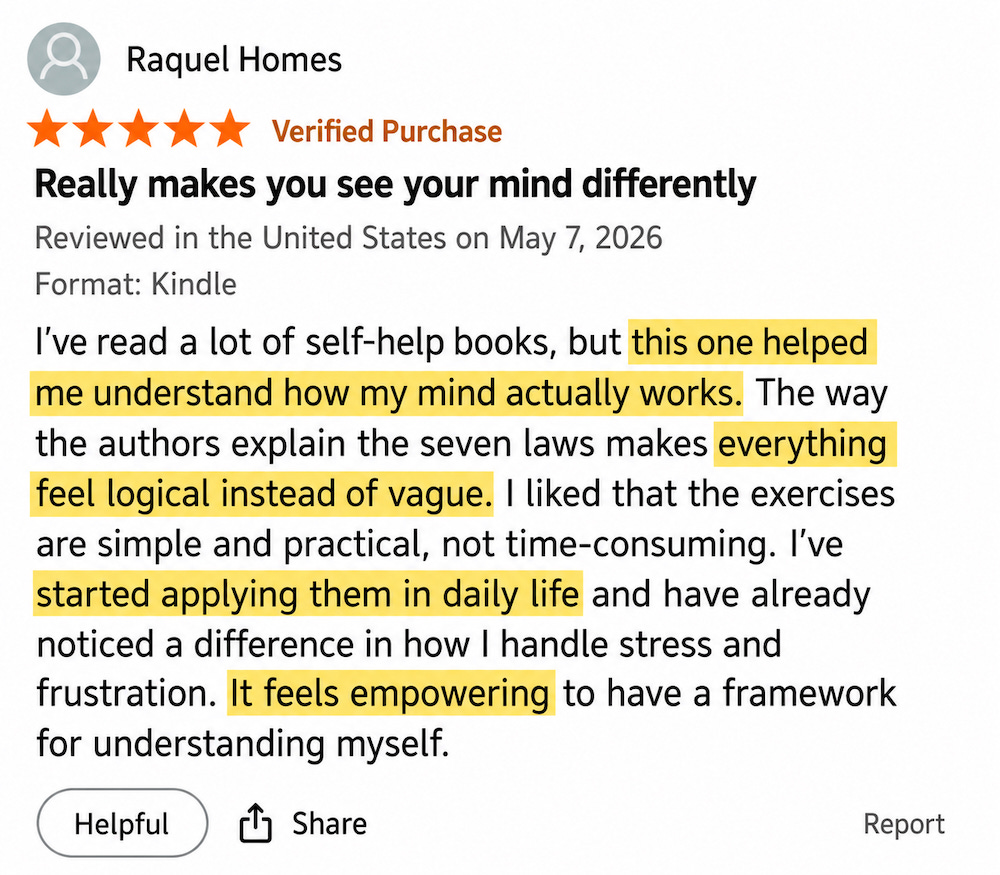
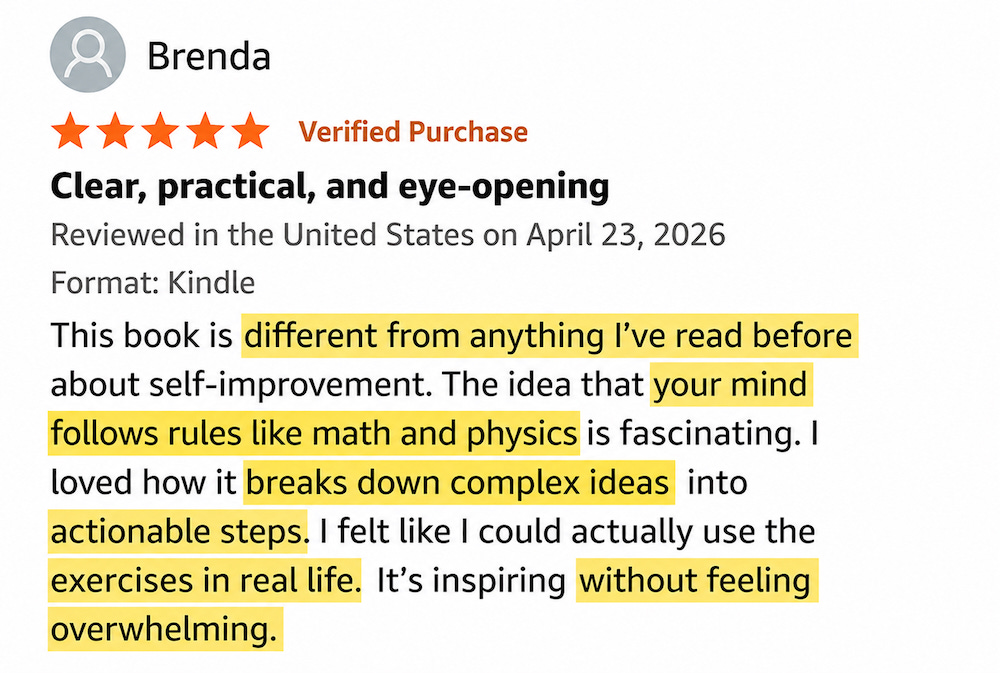
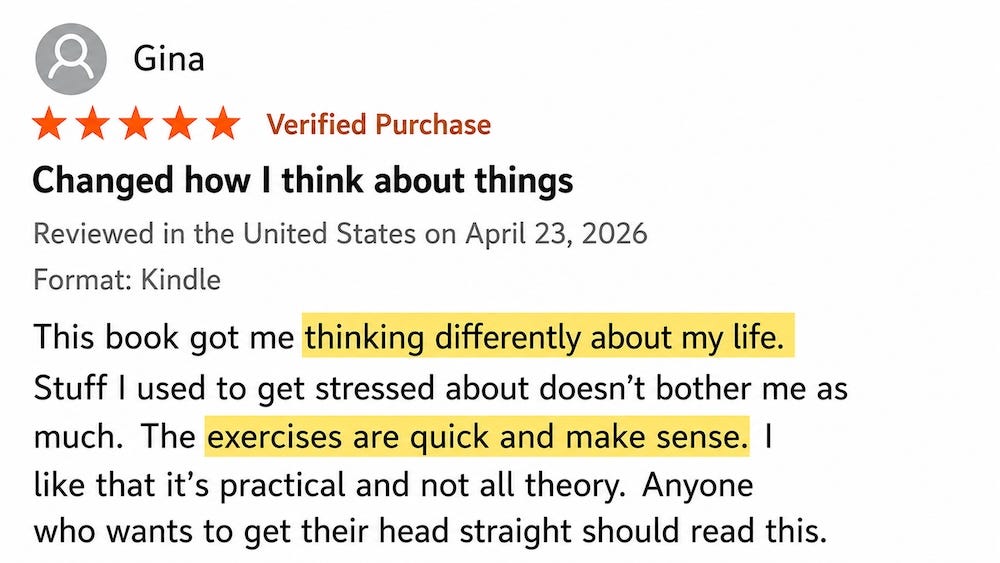
P.S. The story above is taken from the book “The 7 Universal Laws.” If you’d like to discover more stories and learn how to apply the universal laws to solve difficult problems, read or listen to the book.


More from Monica, Stefan and the Inspired Life Circle team.
Join us at the next live, free, online workshops here.
June 9 - Discover the 7 Ways Rich People Think That No One Ever Told You

A live intensive workshop with Monica Ion, founder of the FTP Methodology, for high-achieving professionals whose income, confidence, and growth stalled, despite their effort and ambition.
June 16th - Breaking The Trauma Cycle: How to Transform Your Trauma Before It Becomes Your Child’s

A free live workshop on how to protect your child from your own inner wounds, through Monica Ion’s signature process for dissolving them at the root.