

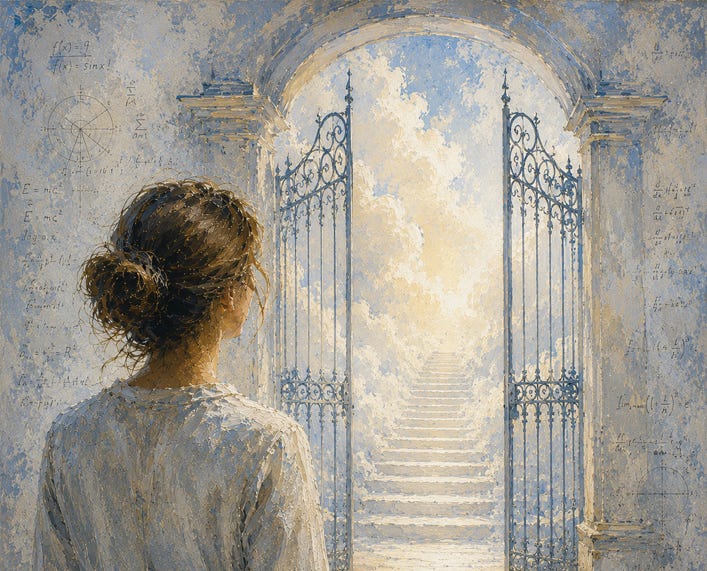
There is an old story about a woman who dies and arrives at the gates of heaven.
There, she is greeted by St. Peter.
He smiles warmly and asks a simple question:
“Who are you?”
The woman answers confidently, “I’m the wife of General Johnson.”
St. Peter shakes his head gently.
“I didn’t ask who your husband is. I asked who you are.”
She pauses, slightly puzzled.
“Well… I’m the mother of John, Eliza, and Carolyn.”
Again, St. Peter smiles.
“I didn’t ask who your children are. I asked who you are.”
Now visibly uncomfortable, she tries again.
“I’m a CPA. I spent thirty years building my career.”
“But that is what you did,” St. Peter replies. “It is not who you are.”
For the first time, the woman has no answer.
No title.
No relationship.
No accomplishment.
Just silence.
Finally, she whispers, “I don’t know who I am.”
St. Peter looks at her kindly.
“Then perhaps,” he says, “you should go back and find out.”
And with that, she suddenly awakens from a coma back on Earth.
We think about this story often because it feels less like fiction and more like a glimpse into our future.
For centuries, human beings have defined themselves through roles, professions, and productivity.
I am a lawyer.
I am a founder.
I am a manager.
I am a writer.
I am a doctor.
But what happens when AI can do nearly all of those things better, faster, and cheaper than we can?
What happens when the thing we built our identity around is no longer uniquely ours?
That is not just an economic question.
It is a deeply human one.
Because in 5, 10 or 15 years, many of us may be forced to confront the same question St. Peter asked:
“Who are you?”
Not what do you do.
Not what have you achieved.
Not how the world labels you.
But who are you when all of that is stripped away?
And perhaps that question, uncomfortable as it may be, will lead us toward something important:
A deeper understanding of what it actually means to be human.
Love and Wisdom,
Monica and Stefan
Ohhh my... who am I.... I AM that I Am.!! I Am a 'Shining Star' waiting to explode.!